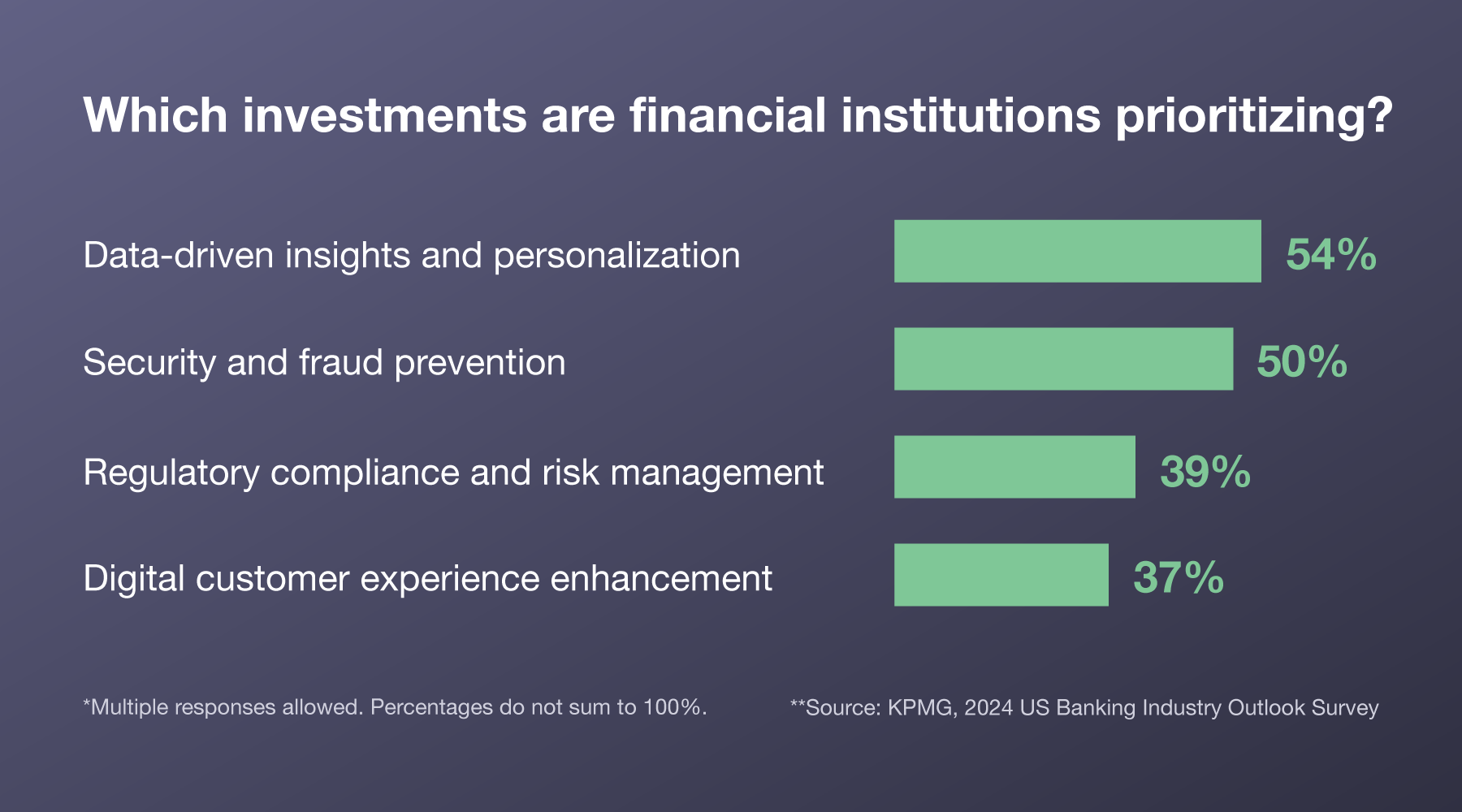
Is it possible to balance security, and customer convenience? Financial institutions have grappled with that question since the 1990s, when Wells Fargo introduced the first online bank accounts, and continue to explore technology’s potential to deliver a secure, frictionless customer experience. A KPMG study identified the top four investment priorities for financial service providers as: 1) personalization; 2) security and fraud prevention; 3) regulatory compliance and risk management; and 4) digital customer experience enhancement.
“As banks progress along the digital transformation journey, they are increasingly able to focus on building and enhancing capabilities that will be differentiated and personalized to customers”, KPMG researchers wrote. “Data insights are the foundation, enabling banks to develop products, services and experiences that are focused on the individual and not the generic ‘anyone’ consumer”.
Researchers noted that customers expect to have secure, private, personalized mobile and online banking experiences and will share their data to make that happen. While this data is foundational to user experience design, harmonizing security, and personalization has been far from easy for fintechs and financial institutions. Security mandates, privacy laws, and consumers themselves, can dictate how their information is shared, transmitted, and stored.
“This undeniable pressure on resources to address regulatory expectations will demand a greater focus on risk and compliance transformation in the sector”, KPMG wrote. “Banking leaders will have to have thoughtful conversations about the strategic investments needed to simplify, rationalize, and centralize risk and compliance frameworks, processes, and controls”.
Unified, user-centric design
After years of iterative progress, financial institutions are blending technology and user-centric design to create unified commerce experiences without sacrificing security. Recognizing that every transaction is an opportunity to deepen customer relationships, banks and fintechs are making every milestone of every user journey, from authentication, transaction confirmation, and help desk identification, more interactive, intuitive, and secure.
At Futurae, we believe that a unified banking UX starts with the right authentication infrastructure. In a world where a generic “anyone” customer does not exist, there is clearly no place for one-size-fits-all technology. Users expect to access banking from anywhere on any device in ways that fit their personalities and preferences. This expectation sets a new standard for banking and requires an all-hands approach by product managers, security experts, and other stakeholders committed to delivering holistic security.
Following are examples of how smart design and technology can protect and enrich the user experience in each of the KPMG study’s four key investment areas.
1. Data-driven insights and personalization
Personalization was a top priority for 54% of the 200 U.S. bankers surveyed, who researchers noted are looking for ways to access and utilize data to understand customers and tailor online and mobile banking experiences that address their behavior, financial habits and preferences.
Recent breakthroughs in contextual and passwordless authentication that leverage unique customer attributes, have been found to be more effective in mitigating credential and identity theft and in simplifying the authentication process to enhance the overall user experience.
2. Security and fraud prevention
Robust security was the main concern of 45% of survey respondents, who were committed to fostering trust by preventing customers’ identities and data from being exposed online. Researchers noted that 55% planned to increase budgets to address cybersecurity risk.
Experts advise enterprises to create strong customer authentication (SCA) methods that meet PSD2 and GDPR requirements. SCA requires 2 or more factors, making it more robust than passwords and other single-authentication methods. Dynamic, adaptable, and flexible SCA can serve a diversity of customer skill sets without adding friction to the user journey.
Beyond fraud prevention, stronger authentication directly reduces password-related helpdesk tickets, one of the most common and avoidable operational costs in digital banking.
3. Regulatory compliance
Regulatory compliance was top of mind for 39% of survey respondents. A majority expect to see increased near-term oversight of cyber risk (80%); data governance (67%); financial risk management (60%); emerging or disruptive technology risk (58%); investor regulations (56%); and anti-money laundering measures (50%).
Selective approaches to passwordless authentication, multifactor authentication (MFA), and strong customer authentication (SCA), that meet the highest security standards in their respective areas, can boost compliance, improve efficiencies, and reduce costs. Biometrics and PIN verification further enhance security compliance. Futurae's authentication layer is designed to simplify compliance across MFA, SCA, and biometric requirements, reducing the engineering overhead banks typically absorb to stay current with regulations.
4. Digital customer experience enhancement
Meeting each customer’s unique needs and preferences was key to success for 37% of banking executives surveyed by KPMG. The ability to leverage technology across all touchpoints is critical and banks are accelerating investment in new capabilities to create better customer experiences.
“Finally, banks are implementing multiple critical enablers of all of their digital channels, led by biometric authentication (44%), predictive analytics and AI-driven personalization (32%), such as chatbots and virtual assistants (28%), and voice banking (22%)”, researchers wrote.
One investment, multiple returns
The pressure on banks to deliver seamless digital experiences while staying ahead of fraud and regulation isn't going away. If anything, customer expectations keep rising and the compliance landscape keeps shifting. For the teams responsible for digital banking, from product and security to operations and compliance, that tension shows up in very practical ways: helpdesk queues full of password reset requests, engineering cycles spent on compliance updates, and customer drop-off at authentication steps that feel outdated.
The good news is that these problems are increasingly solvable with the same investment. Modern authentication infrastructure doesn't just reduce friction for customers, it cuts password-related support tickets, simplifies regulatory compliance, and gives product teams the flexibility to personalize experiences at scale. Security and convenience no longer have to pull in different directions.
For financial institutions ready to move beyond patching legacy systems, the opportunity is to build an authentication layer that serves every stakeholder: customers who want a smooth experience, security teams who need robust protection, and business stakeholders who need to show results.